
Description
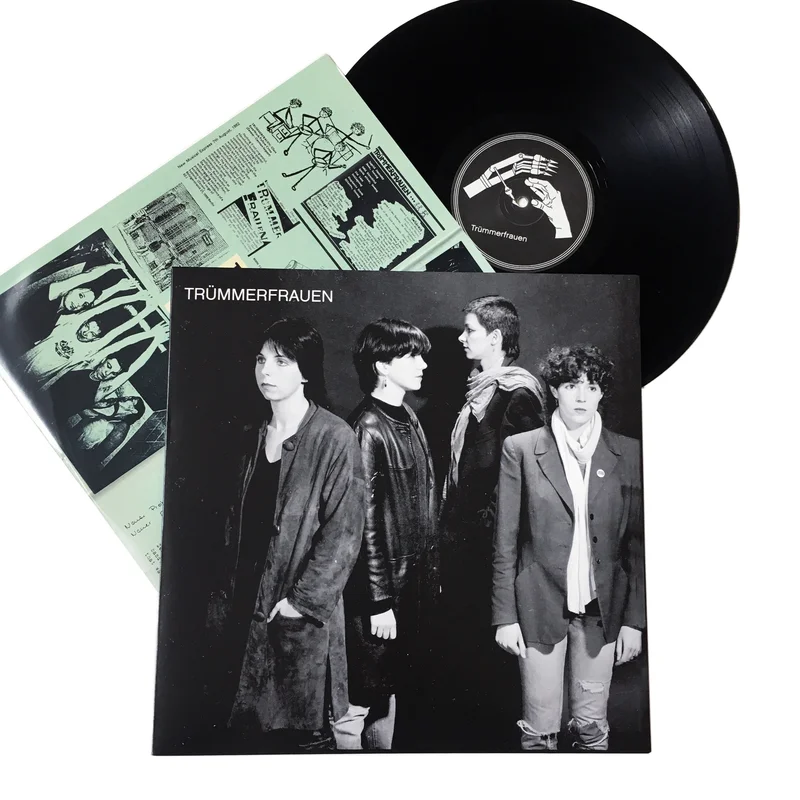
It’s the end of 1979, in Ludwigshafen, Ingrid (bass) and Pia (drums) want to start a feminist punk band. The two young women do not yet know how to play any instruments. They only know that they want to play, and meet other women like themselves. Less than 30 minutes away by car in Heidelberg is where Stephanie (guitar) lives. She responds to an advertisement from two young women who mention they’re looking for a guitarist, without really knowing why. April 5th, 1980, the women play in front of their first public audience. At this point they call themselves “Knitterfrei”. Starting in November 1980, they decide on the name “Trmmerfrauen”, thinking that their music had evolved with the arrival of Gabi (synth). Very quickly, they will become associated with the Mannheim Punk scene (the city that neighbors Ludwigshafen, separated by the Rhine). In November 1981, the band records their first 7″ in Berlin which will be released by Zensor. A few months later, in April 1982, Pia quits the band. Stephanie, Ingrid, and Gabi decide to continue Trmmerfrauen.
This will be the beginning of the end.
Our take: Discography release from this early 80s German post-punk quartet, and while its probably amateur hour to compare a band that sounds like this to Kleenex, its the best I can give you right now. I mean, its not like Trummerfrauen sound exactly like Kleenex, but when youve got this kind of rickety post-punk sound with standard rock band instrumentation (there is a synth, but it doesnt play a huge role on most tracks) and its fronted by one or more women yelling at you with a thick German accent its really hard to get away from that Kleenex comparison. Trummerfrauen are definitely a bit rawer and louder, though, lacking many of the more overt pop elements of Kleenex and LiLiPUT in other words, there arent a lot of tracks here that youll be humming later in the day. Thats not to say that this isnt a great listen, its just thatlike a lot of post-punk musicthe emphasis seems to be more on densely interwoven rhythms than on conventional pop melody. And the lyricswhich are split roughly 50/50 between German and Englishare really cool and obviously well thought-out as well, providing an interesting window into a very late 70s / early 80s take on feminism. Its obvious that the members of Trummerfrauen were plugged into a lot of interesting things happening during their time, and their way of enthusiastically cramming them together in the bands music and presentation is infectious.
Reviews
There are no reviews yet.